
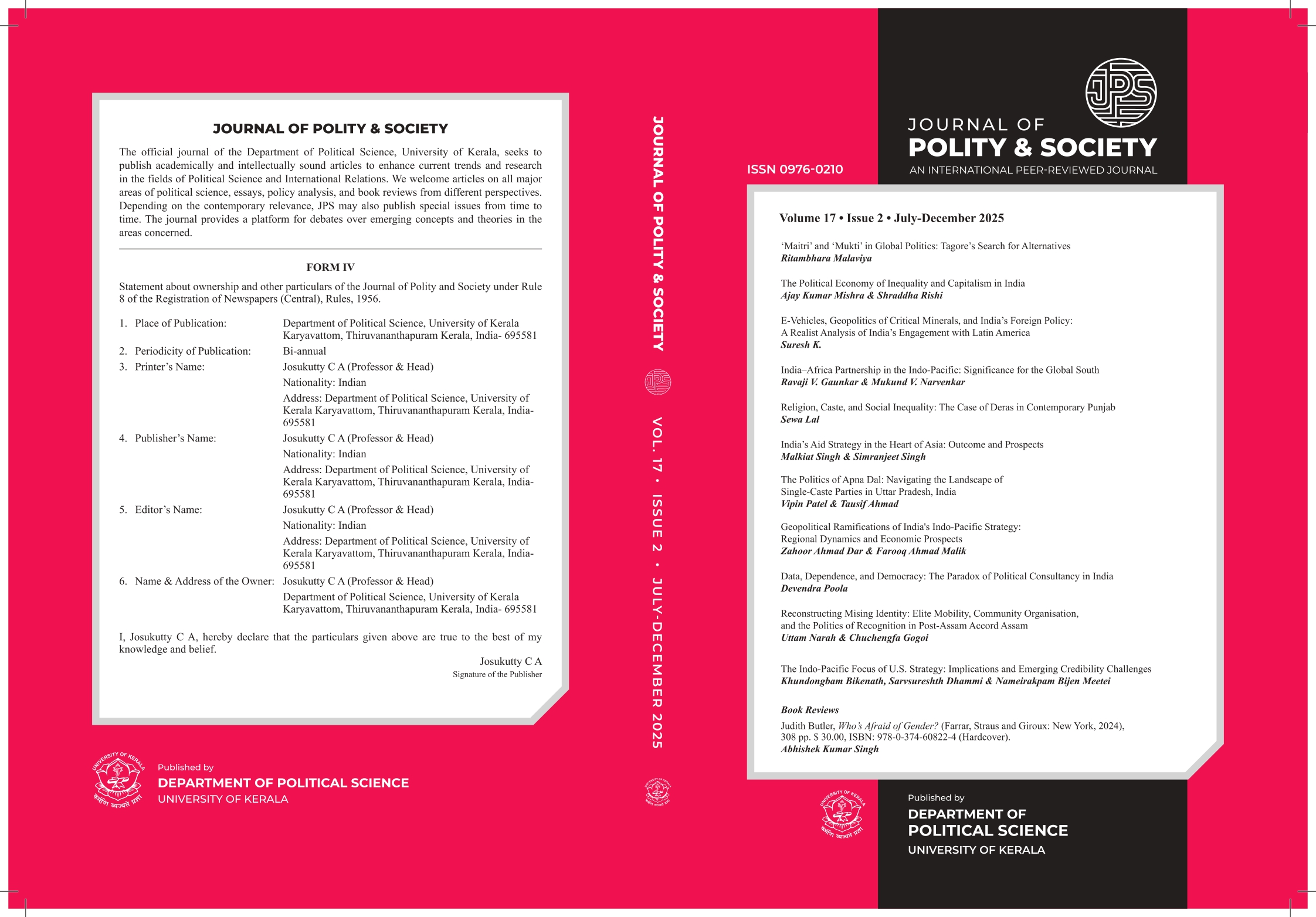
Data, Dependence, and Democracy: The Paradox Political Consultancy in India
- Keywords:
- Political Consultancy, Indian Politics, Democracy, Political Parties, Digital Campaigning, Principal-Agent Framework
- Abstract
-
Political consultancy has become an important force in India’s electoral landscape. It is influencing how parties organise campaigns, interpret voter behaviour, and exercise internal authority. This paper examines how data driven consultancy practices alter the relationship between political parties and external strategists and analyses the implications for democratic accountability. The paper argues that data-driven political consultancy in India has created a new principal–agent relationship in which parties become structurally dependent on consultants who control data, digital infrastructure, and interpretive analytics. Drawing on fifty semi-structured interviews and a principal– agent framework, the study shows that data-driven consultancy creates structural dependence by controlling voter data, digital infrastructure, and analytics. This generates agency costs such as algorithmic opacity and data lock-in, weakening internal party deliberation, oversight, and democratic accountability. By foregrounding these mechanisms, the paper shows how data-centric consultancy enhances campaign efficiency while simultaneously introducing new democratic vulnerabilities that existing scholarship has largely overlooked. The paper concludes that the rise of political consultancy in India represents a paradox of democratic modernisation.
- Cover Image
-
- Downloads
- Published
- 07-02-2026
- Section
- Articles
- License
-
Copyright (c) 2026 Journal of Polity and Society

This work is licensed under a Creative Commons Attribution-NonCommercial 4.0 International License.
