India’s Aid Strategy in the Heart of Asia: Outcome and Prospects
- Keywords:
- India-Afghanistan relations, Aid Diplomacy, International Negotiation, Taliban
- Abstract
-
The paper provides a thorough analysis of India's aid strategy towards Afghanistan since 2001, including its development, distinguishing traits, and broader geopolitical significance. It contends that rather than engaging in any kind of military action, India has taken a clearly development-oriented approach, concentrating on civilian reconstruction, institution-building, and the provision of people-focused services. The study emphasizes India's reliance on soft power, long-term developmental partnerships, and non-conditional assistance as the fundamental pillars of its engagement by placing its model alongside those of the United States, the United Kingdom, Russia, China, Pakistan, Iran, and major multilateral organizations. It also examines the strategic reasons for India's engagement, such as the need to secure access to Central Asian markets and energy resources, stabilize the region, and counterbalance Pakistan's influence. The paper argues that India’s aid strategy in the Heart of Asia represents a form of strategic developmentalism, wherein development assistance functions simultaneously as a tool of capacity-building and a non-coercive instrument of regional influence. The results demonstrate that, despite being constantly put to the test by political unrest, ongoing security risks, and conflicting regional actors' aspirations, India's development cooperation has improved its diplomatic visibility and soft-power influence in Afghanistan. The study concludes that the future effectiveness of India’s aid engagement will depend on its ability to integrate development assistance with broader regional strategies, including multilateral cooperation, alternative connectivity routes, and selective institutional partnerships.
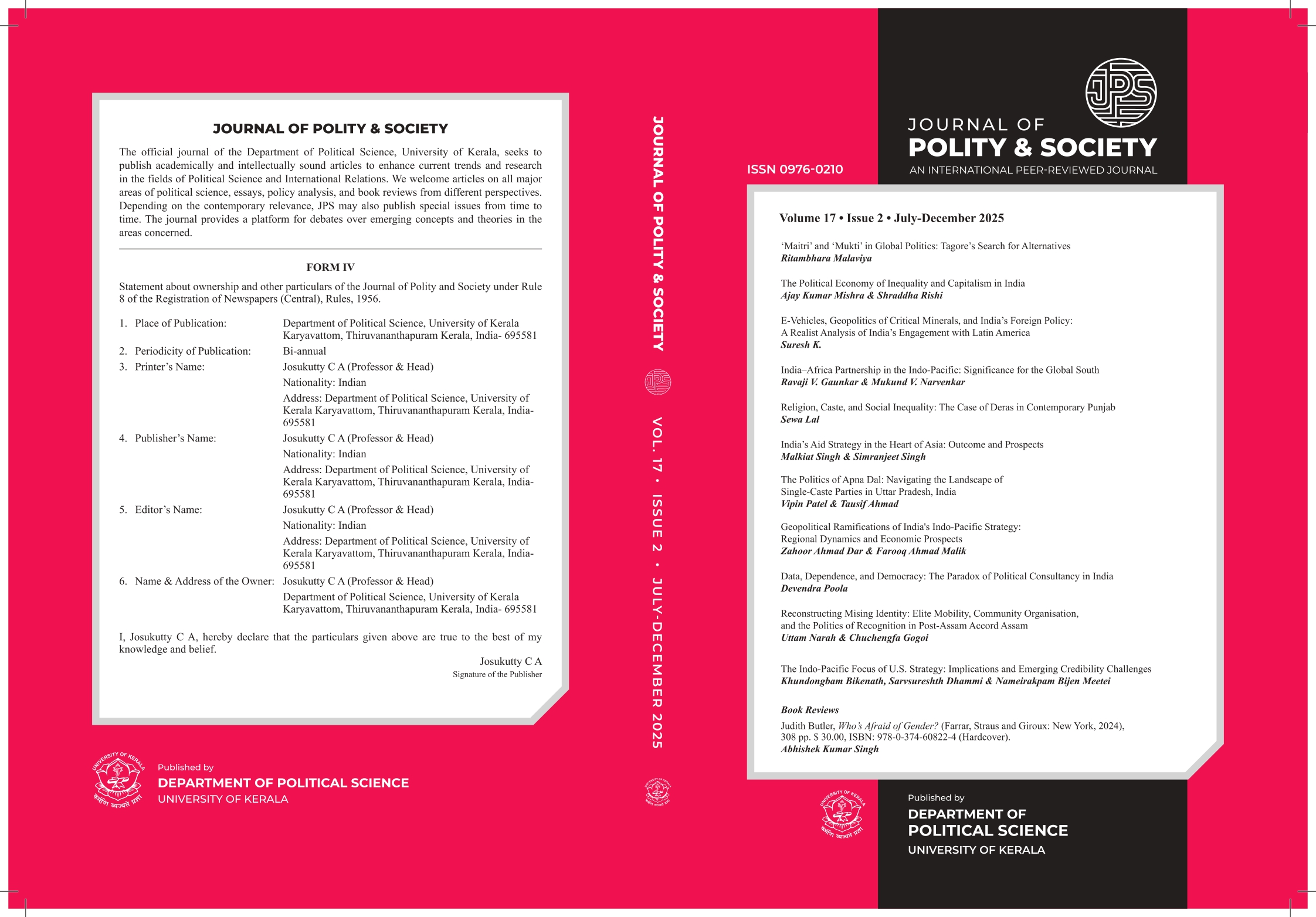
- Cover Image
-
- Downloads
- Published
- 07-02-2026
- Section
- Articles
- License
-
Copyright (c) 2026 Journal of Polity and Society

This work is licensed under a Creative Commons Attribution-NonCommercial 4.0 International License.
