
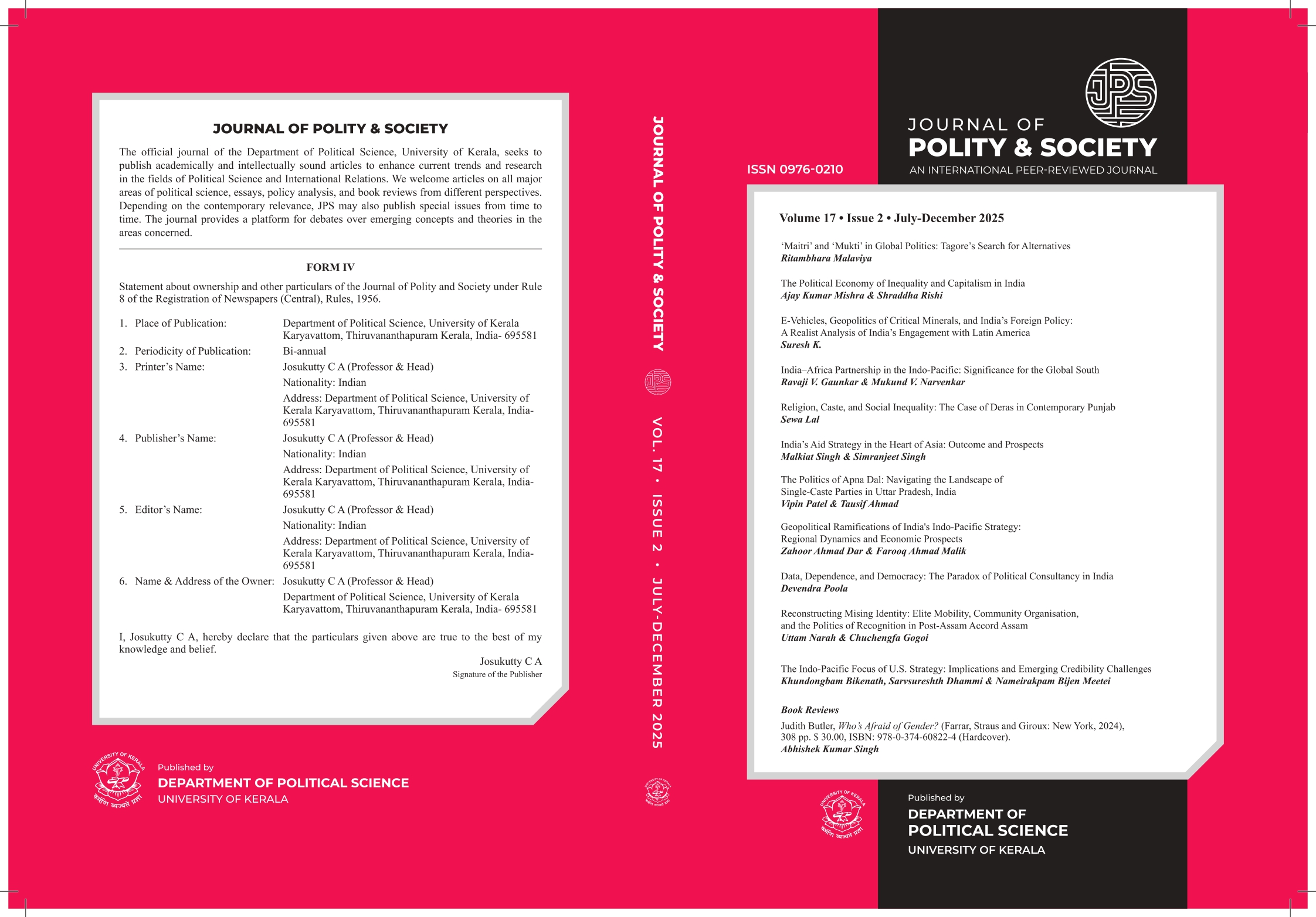
The Indo-Pacific Focus of U.S. Strategy: Implications and Emerging Credibility Challenges
- Authors
-
- Keywords:
- Indo-Pacific Strategy, U.S. Credibility, Regional Perceptions, Non-Traditional Security, Strategic Competition, ASEAN Centrality
- Abstract
-
The Indo-Pacific has emerged as the central arena of contemporary geopolitical competition, positioning the United States as a key actor in shaping regional order amid shifting power balances and expanding security challenges. This study argues that U.S. Indo-Pacific strategy cannot be understood through declaratory policy or military posture alone. Instead, its effectiveness is shaped by the interaction of historical legacies, theoretical logics, material capabilities, normative consistency, and regional perceptions. Drawing on realism, liberal institutionalism, and strategic competition theory, the analysis demonstrates that U.S. credibility is relational and context-dependent rather than solely intent-driven. While credibility remains comparatively strong among formal allies, it is more conditional among middle and smaller powers that prioritise autonomy and economic stability. The prevalence of hedging reflects rational adaptation to uncertainty generated by capability constraints, domestic political volatility, and normative inconsistencies, particularly the tension between maritime law advocacy and non-ratification of UNCLOS. The study concludes that sustained U.S. influence depends on consistent engagement aligned with regional priorities.
- Cover Image
-
- Downloads
- Published
- 07-02-2026
- Section
- Articles
- License
-
Copyright (c) 2026 Journal of Polity and Society

This work is licensed under a Creative Commons Attribution-NonCommercial 4.0 International License.
